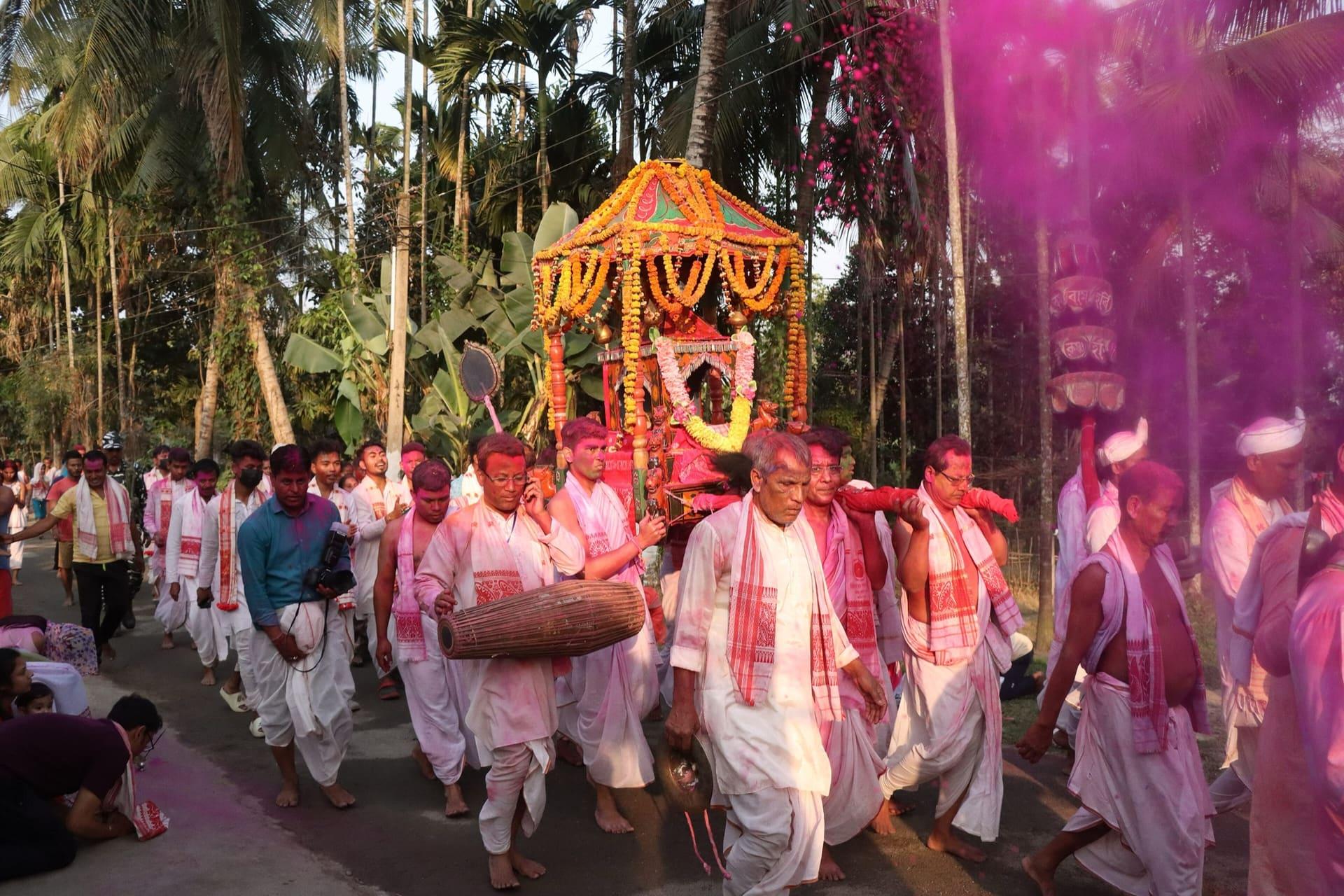
Most religious itineraries in Assam stop at Kamakhya. It is the obvious anchor - one of the most powerful Shakti Peethas in India, on a hill above Guwahati, drawing several lakh pilgrims a year. But treating it as the destination misses what is genuinely unusual about this state, which is the sheer number of traditions that took root here and stayed.
Assam holds Tantric Shakta worship and a homegrown Vaishnavite reformation. It holds a Sufi dargah said to carry a quarter of the sanctity of Mecca, standing on the same small hill as a Vishnu temple that Buddhists also revere. It holds Theravada Buddhist villages in the tea belt, a gurudwara on the Brahmaputra where two Sikh Gurus are held to have come, and - a short drive across the border - some of the finest Welsh Presbyterian church architecture outside Wales.
This is the long version of the circuit. It takes about ten days to do properly, and you can cut it anywhere.
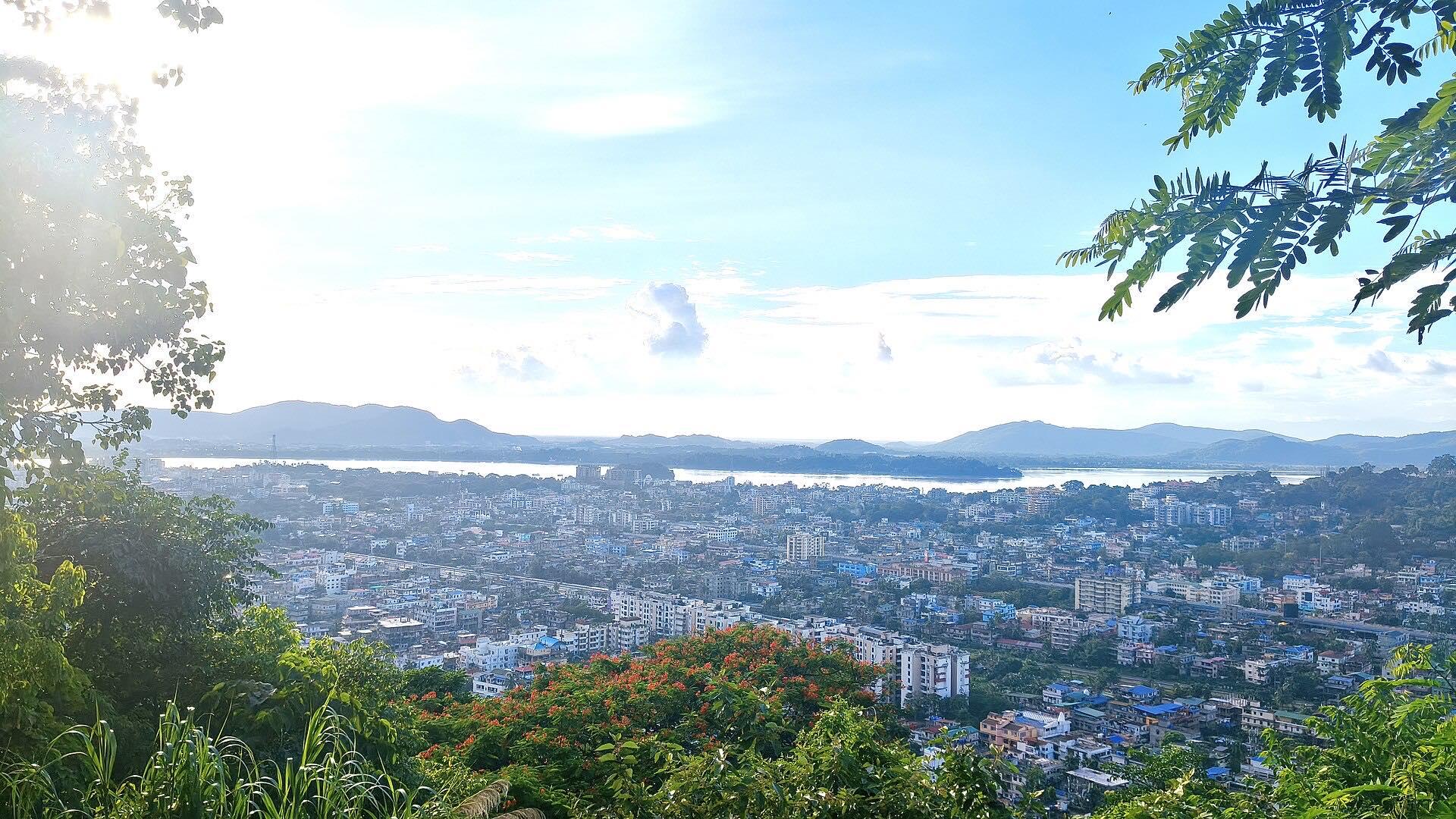
Guwahati: the hill temples
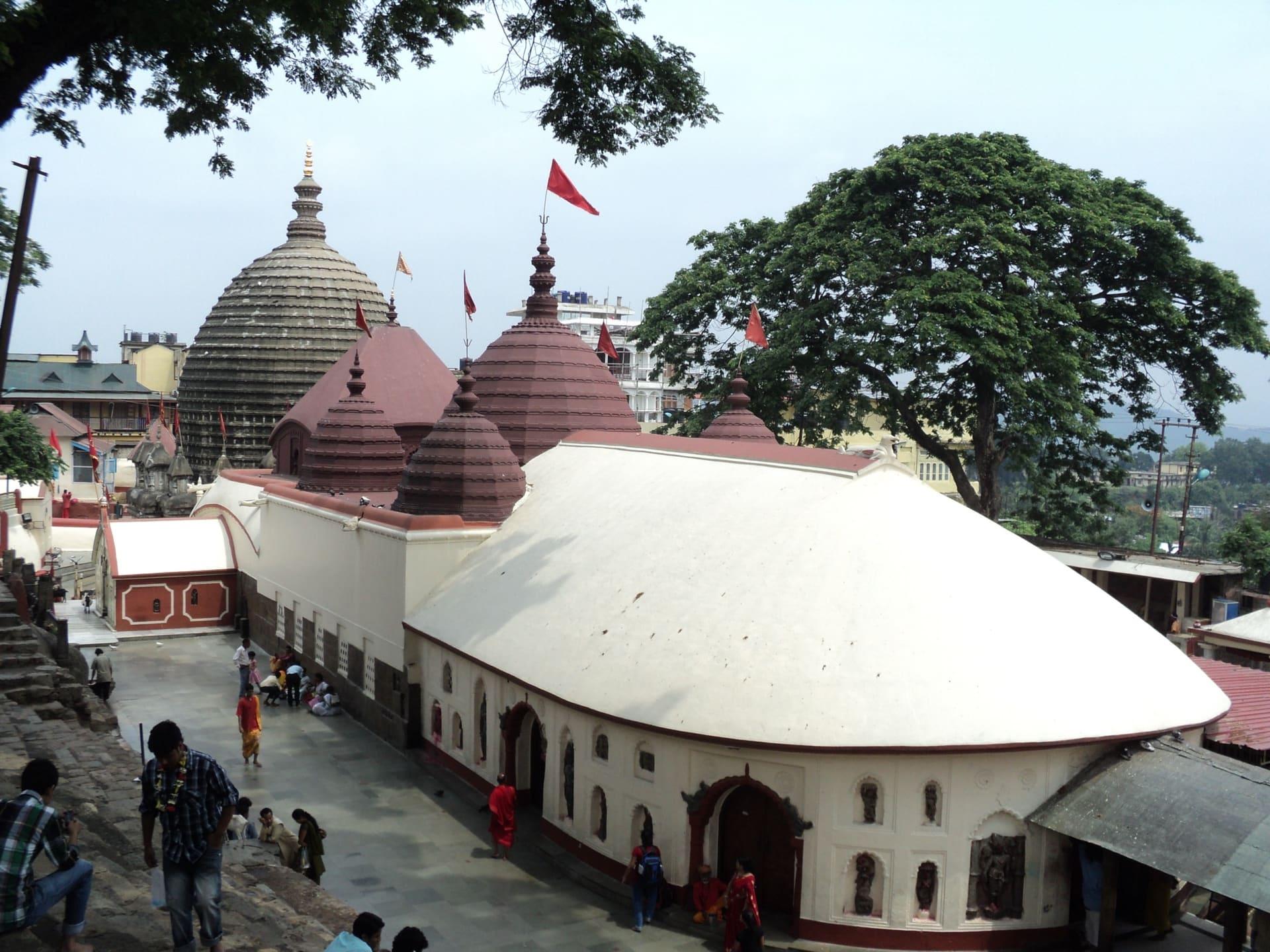
Kamakhya first, and arranged properly - the general queue can run for hours and the VIP darshan pass exists for a reason. The temple sits on Nilachal hill with the Brahmaputra laid out below it, and its most striking feature is what it does not contain: there is no idol, only a natural spring in a cave, and the goddess is worshipped as the yoni. During Ambubachi in June the temple closes for three days and reopens on the fourth, and several lakh pilgrims and sadhus arrive for it.
Then the rest of the city's sacred geography, which almost nobody does. Umananda sits on an island in the middle of the Brahmaputra, reached by ferry - often called the smallest inhabited river island in the world. Navagraha, on Chitrachal hill, is dedicated to the nine planets and points at something older: Guwahati's ancient name was Pragjyotishpura, the city of eastern astrology, and this was a centre of that learning. Sukreswar sits on the riverbank in the old city, Basistha at a hillside spring on the southern edge, and across the water in North Guwahati are Aswaklanta, Dirgheswari and Doul Govinda.
Give the city two days rather than one. The circuit is genuinely better than the sum of its parts, and it explains the river's role in all of it.
Hajo: three faiths on one hill
Half an hour west of Guwahati is Hajo, and it is the most quietly remarkable place on this entire route - because Hindus, Muslims and Buddhists all hold it sacred, and have done for centuries without anyone making a project of it.
The Hayagriva Madhava temple sits on Monikut hill, a stone temple of the Vishnu tradition rebuilt in the 1500s on much older foundations, with beautiful carved elephant friezes around the base. Some Buddhist traditions hold that the Buddha attained nirvana here, and Bhutanese and Tibetan pilgrims come for that reason.
A short distance away is Poa Mecca - the dargah of the Sufi saint Giyasuddin Auliya. The name comes from poa, a quarter: a pilgrimage here is held to carry a quarter of the merit of the Hajj, which for a Muslim in the far east of India was for centuries a matter of enormous practical significance.
Hajo also pairs naturally with Sualkuchi, the silk-weaving town, which is minutes away. One morning covers both.
Madan Kamdev: the ruins nobody mentions
About forty kilometres from Guwahati near Baihata Chariali, on a wooded hill, is a scatter of sculpted stone that gets called the Khajuraho of Assam. Madan Kamdev is a temple complex of roughly the tenth to twelfth centuries, and it is largely ruins - fallen panels, broken figures, a small museum, and carvings that are frankly and unembarrassedly erotic.
The state has never turned it into an attraction, which is exactly its charm. On a weekday you may have the site more or less to yourself, and standing among thousand-year-old sculpture in dappled forest light with nobody selling you anything is a rare experience in Indian heritage travel.
The other Kamakhya, at Silghat
Very few visitors know there is a second one. At Silghat near Kaliabor in Nagaon district, on a hillock directly above the Brahmaputra, stands another Kamakhya temple - described by Assam Tourism as the second Shakti Peeth of the state. It was first established under a Salastambha king and later rebuilt by the Ahom king Pramatta Singha.
It observes Ambubachi as the Nilachal temple does, and it is a completely different experience: quiet, uncommercial, with a panoramic sweep of the river from the top. There is also a Trishuldhari temple at Silghat with the same view.
The practical gift here is location - Silghat is close to Kaziranga, so it slots into a wildlife leg without a detour. A dawn safari and a near-empty Shakti Peeth in the same day is a very Assamese combination.
Sankardeva, and the reformation that came out of a village
In 1449, at Bordowa in what is now Nagaon district, Srimanta Sankardeva was born - and Assam's religious and cultural life has been shaped by him ever since. He built a devotional Vaishnavism around a single formless god, rejected caste hierarchy and elaborate ritual, and did it through art: song, verse, dance-drama and the community prayer hall.
Bordowa Than, at Batadrava, is where he established the first namghar. It is a working religious site rather than a monument, and going there is the single best way to understand why namghars stand at the centre of Assamese villages to this day - as prayer hall, meeting hall and community court in one building.
Then Barpeta, west of Guwahati, where his principal disciple Madhavdeva established the great kirtan ghar. On a festival day, with hundreds of devotees and the drums going, it is overwhelming in the best way.
Majuli: the satras on the river island
Sankardeva's tradition took its most complete institutional form on Majuli, the great river island upstream. The satras there - Auniati, Dakhinpat, Garamur, Kamalabari and others - are monastic centres, still living, where monks are also dancers, drummers and craftsmen.
Samaguri Satra is where the papier-mache masks are made: full-body, articulated, and used in the bhaona dance-dramas that Sankardeva devised as a way of teaching scripture to people who could not read it. Watching one being built - clay, cow dung, cloth, bamboo - is worth the ferry on its own.
Sit in on an evening prayer. The island runs on an older clock and it lets you slow to it. And note that Majuli is eroding: it is measurably smaller than it was a century ago, which lends the visit a certain weight.
Sivasagar: what the Ahoms built
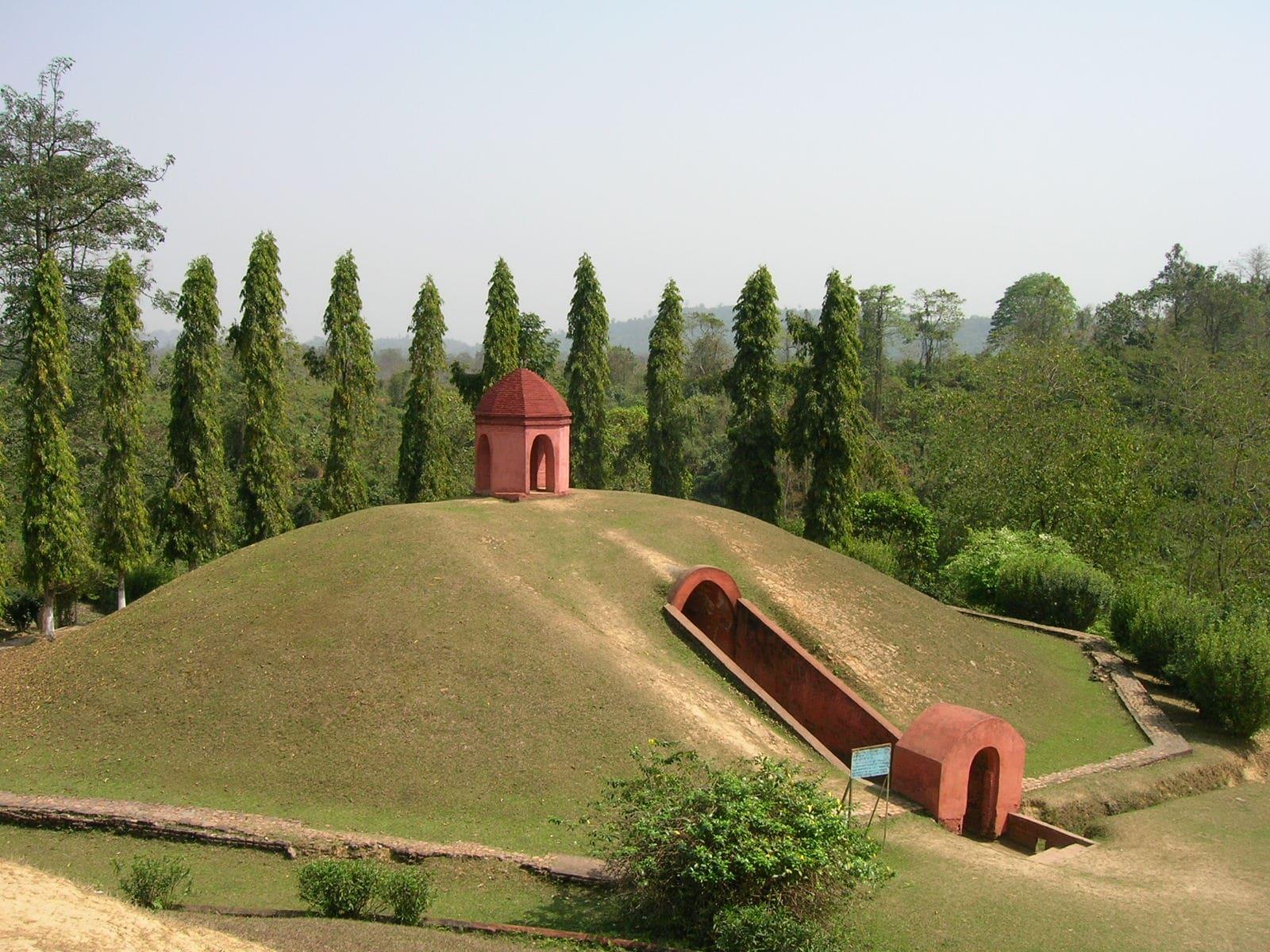
Upper Assam is where the Ahom dynasty ruled for six centuries, and Sivasagar is where they built in brick. Sivadol, raised in the 1730s under Bar Raja Ambika, is often described as among the tallest Shiva temples in India - a soaring curved dol standing beside an enormous man-made tank, with Vishnudol and Devidol alongside it.
The architecture is genuinely its own thing: neither North Indian nagara nor South Indian, but an Ahom form that borrowed and went its own way. On the road towards Golaghat, Negheriting Shiva Doul is a smaller, older, and rather more atmospheric version of the same idea.
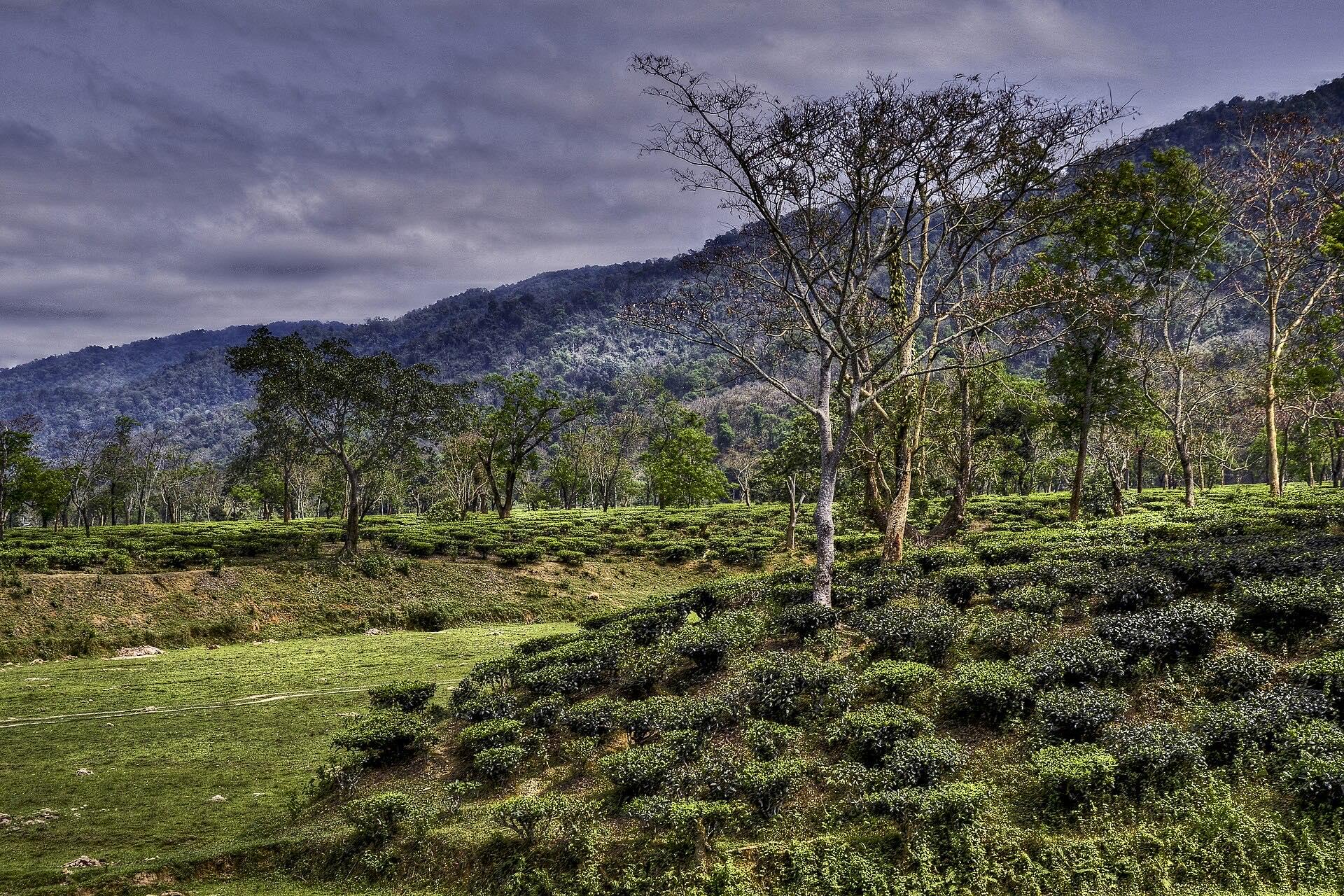
This leg also puts you in tea country, which means a heritage planter's bungalow is the obvious place to sleep.
Buddhist Assam, and a gurudwara on the river
In the tea districts of Upper Assam live the Tai Phake, a small Theravada Buddhist community whose ancestors came from the east. Namphake village near Naharkatia has a monastery on the bank of the Buri Dihing, with saffron-robed monks, a stupa and a village that observes the Buddhist calendar - about as far from the popular image of Assam as it is possible to get while still being in it.
And far to the west, at Dhubri on the Brahmaputra, is a gurudwara: Sri Guru Tegh Bahadur Sahib, also called Damdama Sahib. Guru Nanak is held to have come this way in the early sixteenth century, and Guru Tegh Bahadur later camped here during a Mughal campaign in Assam. It is a working Sikh shrine on the edge of the river, and it completes a picture of the state that a temples-only itinerary would never show you.
Over the border: Meghalaya's churches - and a Shakti Peetha
This last leg leaves Assam, and it is worth the three hours. Meghalaya is overwhelmingly Christian, the legacy of Welsh Presbyterian missionaries who arrived in the Khasi hills in the 1840s, gave the Khasi language its written script, and left behind a landscape of stone churches with tin roofs on ridge after ridge.
In Shillong, the Cathedral of Mary Help of Christians is the grand one - blue-washed, with good stained glass - and All Saints' Cathedral is the Anglican counterpart. But the small hill chapels are the more affecting sight, and Khasi hymn singing in four-part harmony is something you should arrange to hear at least once.
And then the surprise: at Nartiang in the Jaintia Hills stands the Nartiang Durga temple, counted among the fifty-one Shakti Peethas, in a state that is otherwise Christian. It sits near the Nartiang monoliths, a field of standing stones raised by Jaintia chieftains. Two entirely different sacred traditions, ten minutes apart, both still in use.
How we would route it
Ten days does the whole thing: two in Guwahati for the hill temples, a morning at Hajo and Sualkuchi, an afternoon at Madan Kamdev, then east to Bordowa, Silghat and Kaziranga, on to Majuli by ferry, up to Sivasagar and Namphake, and finally the run into Meghalaya for Shillong and Nartiang. Barpeta and Dhubri are a western add-on of two more days.
Six days covers Guwahati, Hajo, Madan Kamdev, Silghat, Kaziranga and Majuli, which is the strongest short version.
Come between October and April. Come in June if you specifically want Ambubachi at Kamakhya, and talk to us months ahead if so, because Guwahati fills completely. We arrange darshan, we know which satras welcome visitors at prayer time, and we will tell you honestly which sites are worth the drive and which are a photograph.