The first thing about Sualkuchi is the sound. You get out of the car and there is a rhythm coming from every direction at once - a wooden clack-clack, clack-clack, thousands of them, overlapping and slightly out of phase, from inside houses on both sides of every lane. It is not machinery. It is handlooms, and there is one in almost every home.
They call it the Manchester of the East, which was somebody's colonial compliment and has stuck. It undersells it. Manchester had mills. Sualkuchi has households.
Muga, which belongs to Assam and nowhere else
Assam weaves three silks. Pat is white and lustrous. Eri is warm, matte and often called peace silk, because the moth is allowed to leave the cocoon. And then there is muga.
Muga is produced by Antheraea assamensis, a semi-domesticated silkworm that lives on som and soalu trees and exists nowhere else in the world. The thread comes off the reel a deep natural gold - undyed, that is simply the colour - and it does something no other silk does: it gets glossier with every wash. A good muga mekhela chador outlasts the woman who bought it and is handed on. Grandmothers' garments are worn at weddings sixty years later, brighter than when they were made.
Who is at the loom
Walk into any of these houses - and you should, they will wave you in - and the person working is almost always a woman. In the house we usually take people to, that is Rekha baideu, who has been at the same loom since she was fourteen and can tell you what every motif in the border is called without looking up. Weaving in Assam has historically been women's work and women's knowledge, taught mother to daughter, and for a very long time a woman's skill at the loom was considered part of who she was. Sankardeva wrote about Assamese women weaving dreams into their fabric. He was not being entirely metaphorical.
What that means in practice today is a household economy run largely by women. She sits at a throw-shuttle or fly-shuttle loom in a room off the courtyard, often with the loom taking up most of it, and works between cooking and school runs and everything else. A plain mekhela chador might take a week. An intricate one - with kingkhap or miri motifs, or a heavy pari border - takes a month, sometimes two, and every one of those threads was placed by a person.
What a mekhela chador actually is
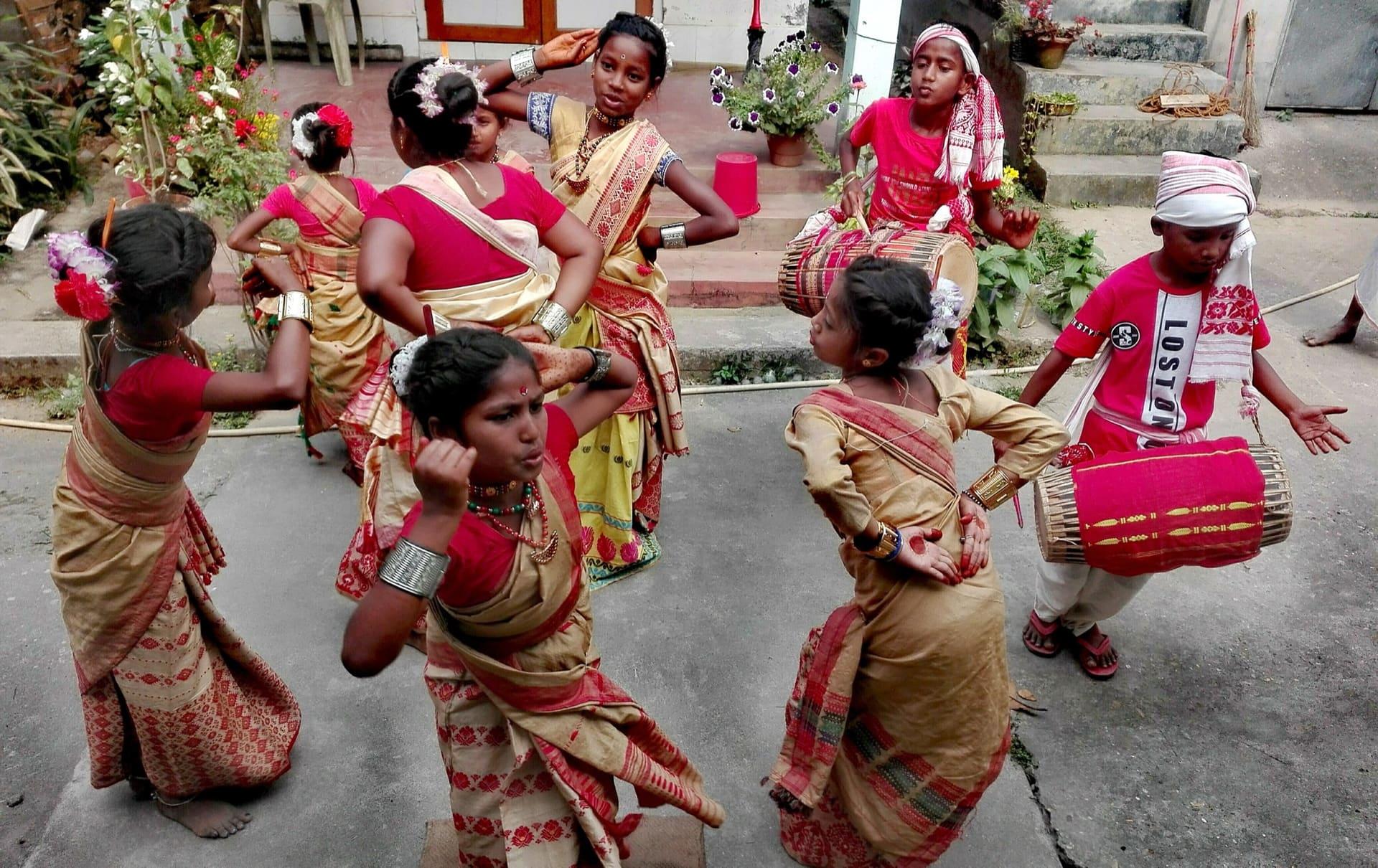
Two pieces. The mekhela is the lower garment - a wide cylinder of cloth, pleated at the waist and tucked, worn long. The chador is the upper: a longer piece, one end tucked into the mekhela in triangular folds, the rest draped across the chest and over the shoulder.
It is not a saree and Assamese women will gently correct you if you call it one. The drape is different, the pleating is different, and the motifs mean things - the diamond kingkhap, the jaapi, the flowering gos buta. Watching someone put one on properly in about ninety seconds, having watched a tourist take fifteen minutes, is its own small pleasure.
Buy it here, and buy it honestly
Sualkuchi is where you buy one, and the reason to buy in the house rather than the showroom is that the money lands in the right place. A genuine muga mekhela chador is expensive - real ones start in the tens of thousands and go well up from there - and that is because a person spent a month of their life on it.
There are cheap ones. They are polyester or they are art silk, they are machine-made, and they will be sold to you with enthusiasm. Real muga has a slightly uneven natural gold, a dry rustle rather than a slippery one, and a weight to it. Ask to see the reeling. Ask Rekha baideu what the motif is called. The women who make these things are usually delighted that somebody asked, and you will pay a fair price for something a machine could not make.
Go on a weekday morning
The looms run early. By nine the whole town is going, and by mid-afternoon it thins. It is half an hour to an hour from Guwahati depending on the traffic out of the city, and it pairs naturally with Hajo, which is a short hop further and is one of the very few places anywhere that is a pilgrimage site for Hindus, Muslims and Buddhists at the same time.
Take the morning. Sit in somebody's front room and watch the shuttle go across. It is the most quietly impressive thing within an hour of Guwahati, and almost nobody puts it on an itinerary.