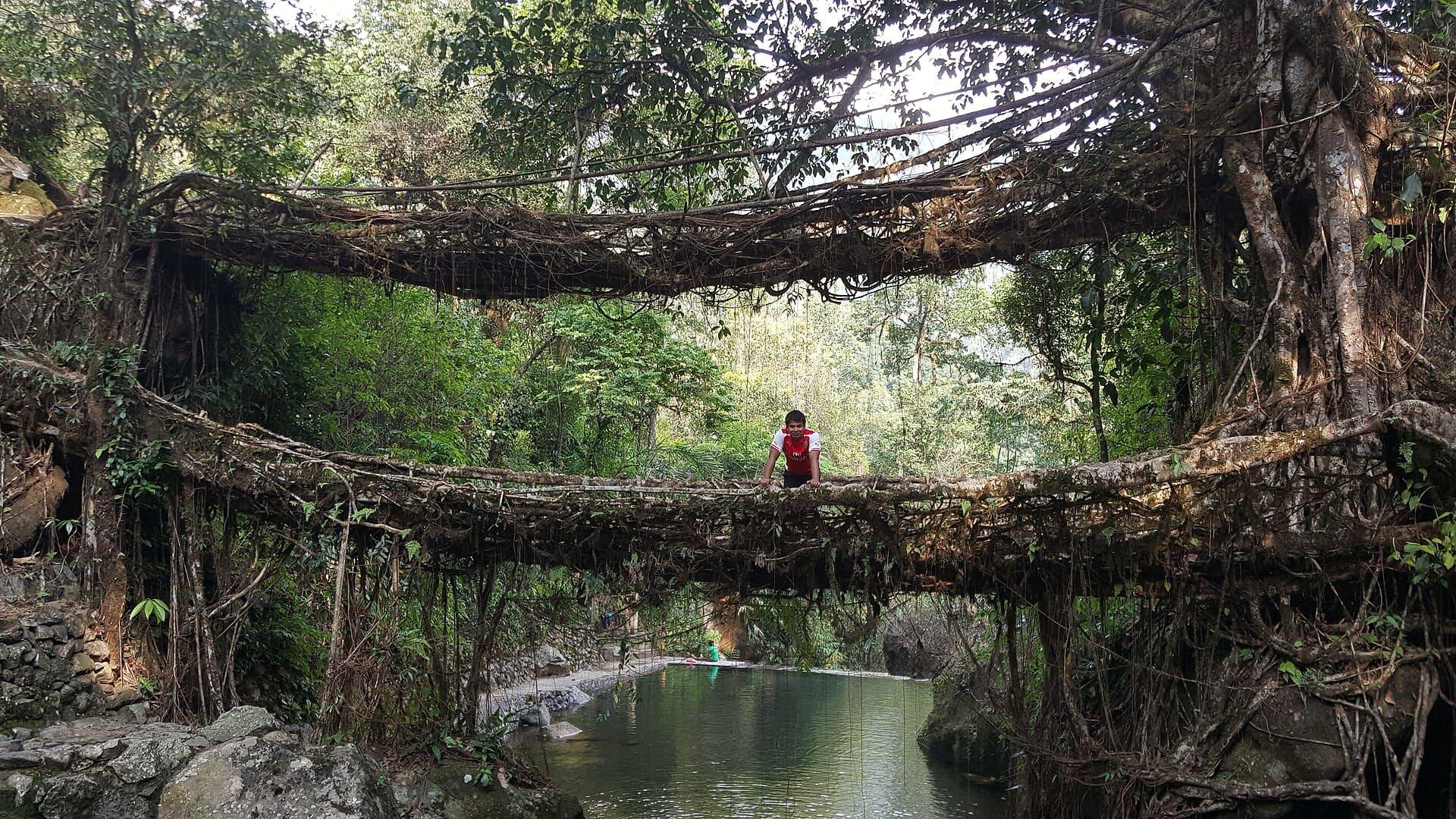
The photograph you have seen is of a bridge with two tiers, dark and knotted, strung across a green pool in a gorge. What the photograph does not contain is the roughly three thousand concrete steps between you and it, or the three thousand back up, or the fact that in Meghalaya those steps are usually wet.
I want to be straightforward about this, because I have watched people arrive at Tyrna in sandals expecting a viewpoint. It is not a viewpoint. It is a hike, and it is one of the best days you will have in India.
Going down is not the easy half
Phrangki meets you at Tyrna, looks at your shoes, and either says nothing or suggests you reconsider. Then you descend. Immediately, steeply, and for a long time. Everyone's instinct is that down is the easy direction; everyone's quadriceps disagree within about fifteen minutes. The steps are uneven, worn smooth in places, and slick with moss where the canopy keeps the sun off.
The gorge closes over you as you go. It gets darker and greener and considerably louder - water everywhere, in channels beside the path, falling off rock faces, running underneath you. Butterflies the size of a hand. The air turns cool and thick and smells like wet stone and leaf litter.
Then you cross the first of the wire suspension bridges, which bounce, and which are the moment most people either start enjoying themselves or start regretting the day.
How the bridges are actually made
The Khasi and Jaintia have been doing this for generations. The tree is Ficus elastica, the Indian rubber fig, which throws out secondary aerial roots from high on its trunk. Those roots are guided - traditionally through hollowed-out betel trunks laid across the water - and trained to the far bank, where they take hold and thicken.
It takes years. Fifteen to thirty before a bridge carries weight properly. And then, unlike anything we build, it gets stronger with age rather than weaker, because it is not a structure - it is a living organism that has been persuaded into a useful shape. Some of the bridges in these valleys are well over a century old and still in daily use by people carrying firewood.
Arriving at Nongriat
You smell the village before you see it - woodsmoke and cooking. Bah Kyrshan's guesthouse is the second one past the bridge, and there is always tea. Nongriat is a scatter of houses with no road to it at all; everything that arrives here arrives on somebody's back down those steps, which reframes the whole hike rather sharply.
And then the bridge. Two tiers, one above the other, roots braided and fused into handrails and a deck, moss on everything, the pool below it a deep clear green. People swim. The water is cold enough to make you shout.
Standing on it is the strange part. There is a small amount of give underfoot, the kind you get from a branch rather than a plank, and it is impossible not to keep thinking: this is growing. It is doing this slowly, right now, while I stand on it. Nobody drew this. Somebody's great-grandparent started it and did not live to walk across it.
Rainbow Falls, if you have the legs
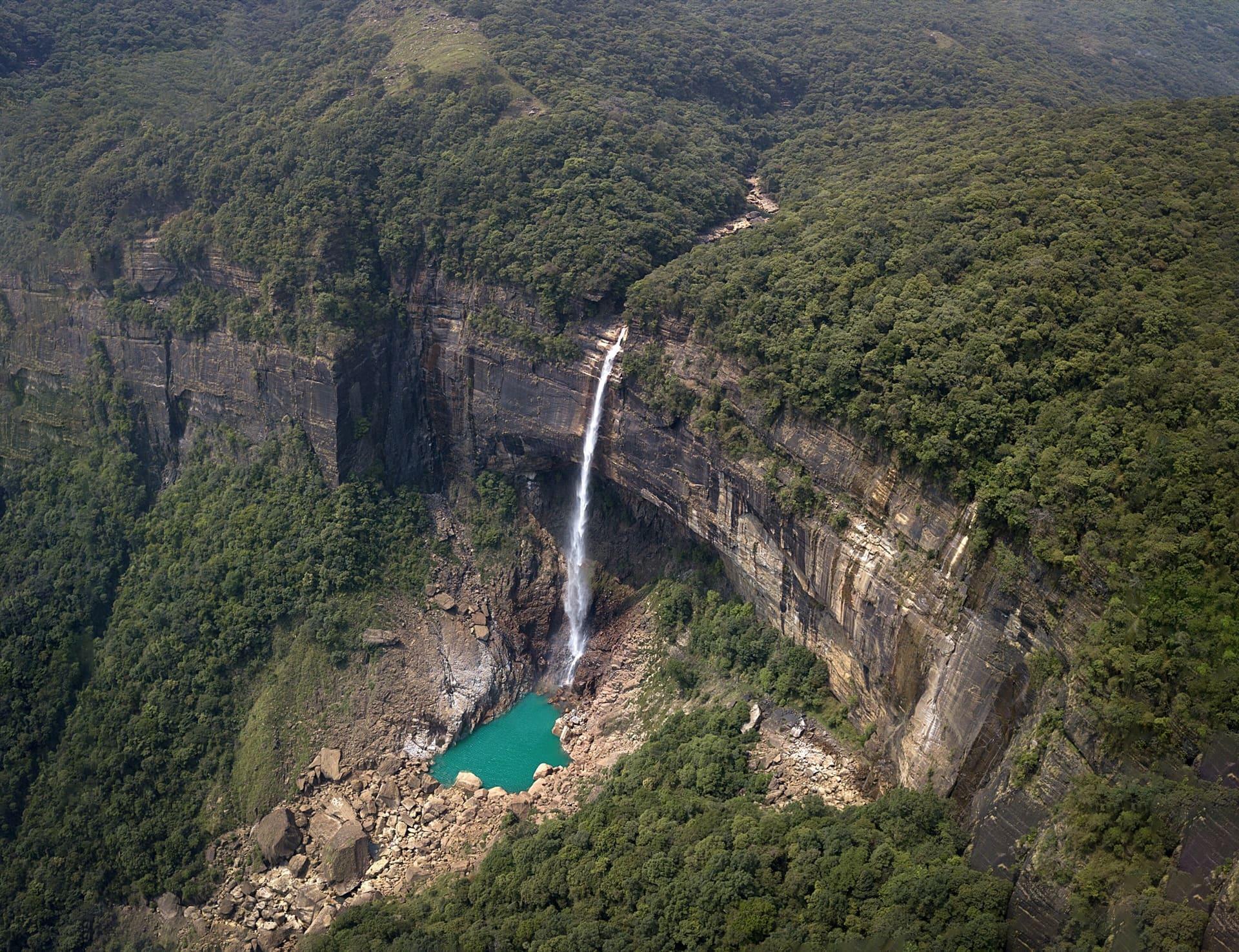
Another hour and a half beyond Nongriat is Rainbow Falls, and it is the better swim - a tall drop into a turquoise pool, and far fewer people, because most day-trippers have already turned around.
It is a real extra, though. Do not attempt it if the return climb is already worrying you. There is no road out and no shortcut; whatever you walk down, you walk back up.
Stay the night. Genuinely.
This is the single best piece of advice I can give about Nongriat. There are basic guesthouses in the village - a bed, a bucket, a plate of rice and dal, not much else.
Do it. By four in the afternoon the day-hikers have gone and the gorge belongs to about twenty people. You swim in the pool with nobody in it. You eat with a family. You sleep to the sound of water so loud it becomes silence. And you climb out the next morning on fresh legs in cool air, rather than dragging yourself up three thousand steps in the afternoon heat with a bus to catch.